

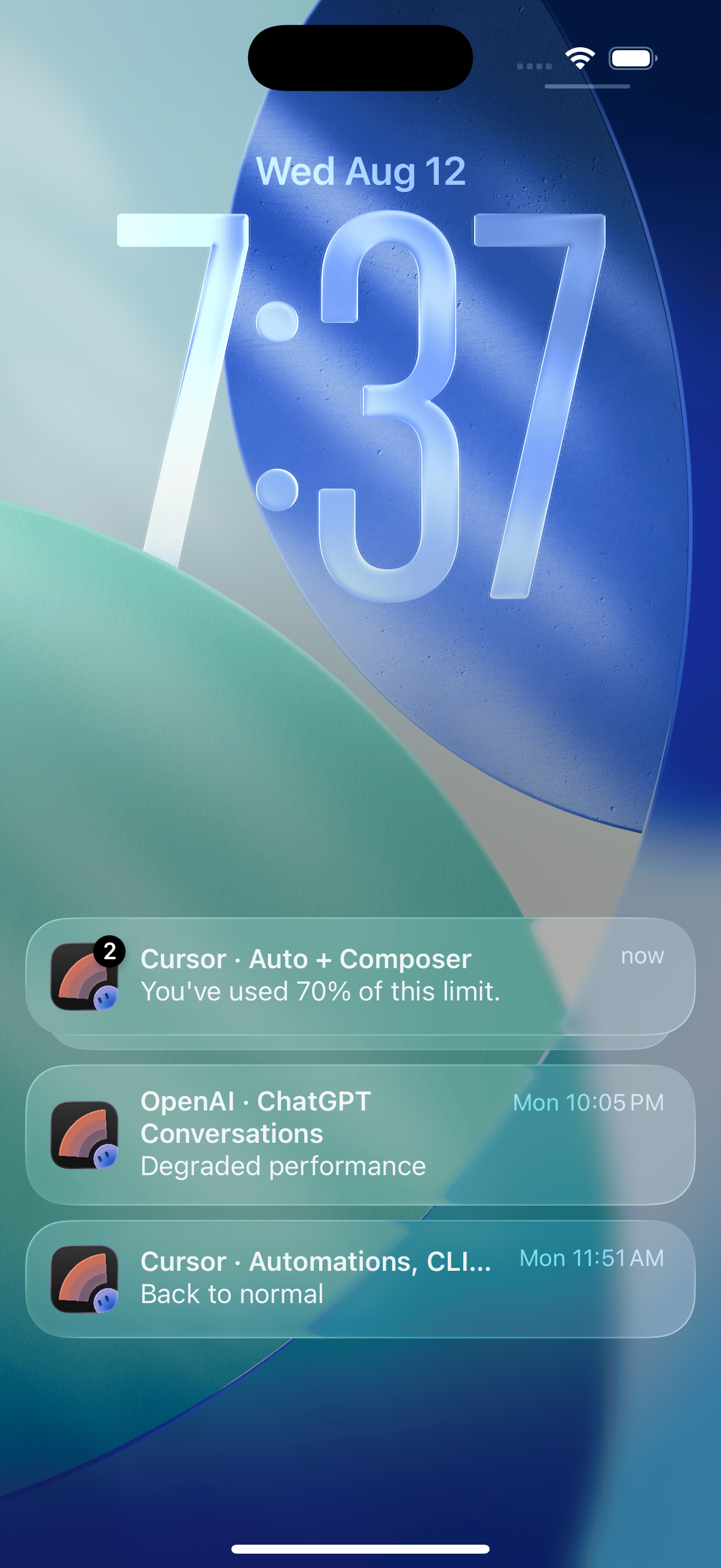
Three at once: a Cursor limit at 70%, an OpenAI service degrading, and another coming back.
Status alerts
One master switch, then a second row once it’s on:
Status comes from each provider’s public status page, so this needs no account.
Choosing services
With the master switch on, a Services section appears below it — Claude, OpenAI, Cursor, xAI, and Gemini, each a collapsible group of that provider’s individual services. Every service starts on. Groups are collapsed by default and the header shows how many are enabled out of the total, so you can see what you’ve changed without opening anything. It’s worth pruning: a provider’s status page lists a lot more than the one thing you actually use.Usage alerts
A heads-up at 70%, 90%, and 100% of whichever windows that provider reports — Claude and Codex have a 5-hour one and a weekly one, Cursor has two monthly pools, xAI a weekly pool, Gemini a daily one. A long afternoon and a heavy week each get their own warning. Toggle these per account, and only for accounts you’ve signed in to.Usage is checked on your phone. Your login never leaves the device and is
never sent to Nomo’s servers — see Signing in.